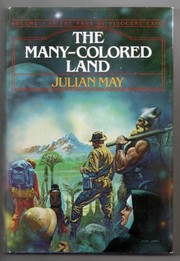
The Many-Colored Land
core novel 1981 Saga of Pliocene Exile
Record
| First published | 1981 |
|---|---|
| Original language |  EN |
| Work type | novel |
| Canon status | core |
| Reader rating | 4.07 (13,766 ratings, collected 2026-09-02) |
| Page count | 415 |
| First-edition ISBN | 0395302307 |
| Internal chronology | 1 |
Synopsis
Published in 1981, The Many-Colored Land is the first novel in Julian May's Saga of Pliocene Exile. It follows a group of twenty-second-century misfits who pass through a one-way time gate to Earth's Pliocene epoch, seeking a simpler life away from a technologically perfect but stifling future. The novel introduces each member of this party in turn, focusing especially on Group Green, which includes a starship captain, an athlete, a paleontologist, and a priest among others. On arrival, the travelers discover the continent is already home to two alien races, the tall and beautiful Tanu and the smaller Firvulag, who are locked in an ongoing, ritualized rivalry.
Where it sits
- Universe: Saga of Pliocene Exile
- Series: Saga of Pliocene Exile core; position 1 of 4 in the series' recorded order
- Author: Julian May
Awards (verified)
- Locus Award (Best SF Novel), 1982: won; Corroborated by two independent secondary aggregators during this admission's research; a direct spot-check against locusmag.com's own award-year index was not completed this session and is worth a follow-up before treating this as fully primary-sourced.
- Nebula Award (Best Novel), 1981: nominated; Verified directly on SFWA's own official Nebula Awards site.
Notes
- From the series record (Saga of Pliocene Exile): The core tetralogy: one continuous story of the Pliocene exiles.
Neighbouring works
Publication order and internal chronology are tracked as two separate orderings and are never conflated: a book's place in one says nothing about its place in the other.
- Publication order, within the series Saga of Pliocene Exile: position 1 of 4: next The Golden Torc (1982)
- Internal chronology, within Saga of Pliocene Exile: position 1 of 7: next Jack the Bodiless (1991)
Sources
- https://en.wikipedia.org/wiki/The_Many-Colored_Land
- https://en.wikipedia.org/wiki/Julian_May
- https://nebulas.sfwa.org/award-year/1981/
← Saga of Pliocene Exile dossier · All universes
Part of the Library. Fields without an identified source are omitted, never guessed.